Immigration Policy Insights
Last Updated: October 2026
Explore Riverside's policy briefs, research, and public discussions examining how immigration policies affect immigrants, their families, and the communities in which they live and work.
RIVERSIDE POLICY BRIEF • OCTOBER 2026
A Broken System: The Human and Societal Costs of U.S. Immigration Policy
Riverside's first policy brief examines how increasingly restrictive immigration policies and aggressive enforcement are threatening immigrants' rights, safety, livelihoods, and family stability. The harm extends far beyond immigrant communities, affecting businesses, healthcare, schools, and communities across the country.
Drawing on national research, news reporting, and the firsthand experiences of Riverside participants and alumni, the brief shows how these policies are separating families, disrupting employment, making it harder to access healthcare and legal protections, and creating fear that changes how people live their daily lives.
The brief calls for stronger accountability, meaningful protections for immigrants' rights, and policy changes that address the harm being done to individuals, families, and communities.
The Impact of Immigration Policy on Everyday Life
What Riverside Participants and Alumni Are Experiencing
Immigration policy affects far more than who can enter or remain in the United States. It can shape whether people feel safe working, seeking medical care, attending school, or accessing essential services.
A recent Riverside survey reveals a range of experiences. Over 55% reported that immigration policy or enforcement changes had affected them or their families, others described disruptions to daily life, escalating economic insecurity, and uncertainty about their futures. The findings offer a window into how these issues are affecting Riverside's community.
34%
Immigration concerns are changing everyday life.
About one in three respondents reported changing their daily activities because of immigration concerns, including avoiding public places, healthcare, benefits, or job opportunities, or missing work or classes. 14% specifically reported avoiding public benefits or services.
“Yes, I don't know what happens to me if ICE takes me.”
Another 17% preferred not to answer the question about changes in daily behavior.
63%
Uncertainty makes it difficult to plan for the future.
Nearly two-thirds were unsure or lacked confidence about what to do if they or a family member faced an immigration problem.
“Because of problems with our documents, it is very difficult for me to study and concentrate. I don’t know what will happen with our future, and this is very stressful for me.”
Immigration uncertainty can affect education, emotional well-being, and the ability to plan for the future.
31%
Economic security is at stake.
Finding or keeping a job was the most frequently identified specific concern. Respondents also reported work permit problems, lost income, and interrupted career plans.
“We cannot work, our savings are gone, and our situation is very difficult. We are also afraid of ICE, even though we are following the process correctly.”
Barriers to employment affect household stability and can have consequences for employers and the broader economy.
87%
The pursuit of opportunity continues.
Nearly nine in ten respondents identified English classes as a service they want from Riverside, alongside employment assistance, legal guidance, and other support.
“I am working hard to improve my English, become independent, and build a stable future in the United States.”
Participants continue seeking the skills, support, and opportunities needed to build stable lives.
Why It Matters
The effects of immigration policy are not experienced equally, but they extend well beyond immigration status. When immigration concerns affect people's ability to work, learn, seek healthcare, or access essential services, the consequences can reach the workplaces, schools, healthcare systems, and communities we all share.
Source: Riverside participant and alumni survey, September–October 2026; 94 submissions. Percentages reflect responses to individual questions and are not representative of all immigrants.
PAST EVENTS
The 2026 Immigration Landscape: A State of the Field Summit
March 31, 2026 | 10:00 am | In-Person | NYC
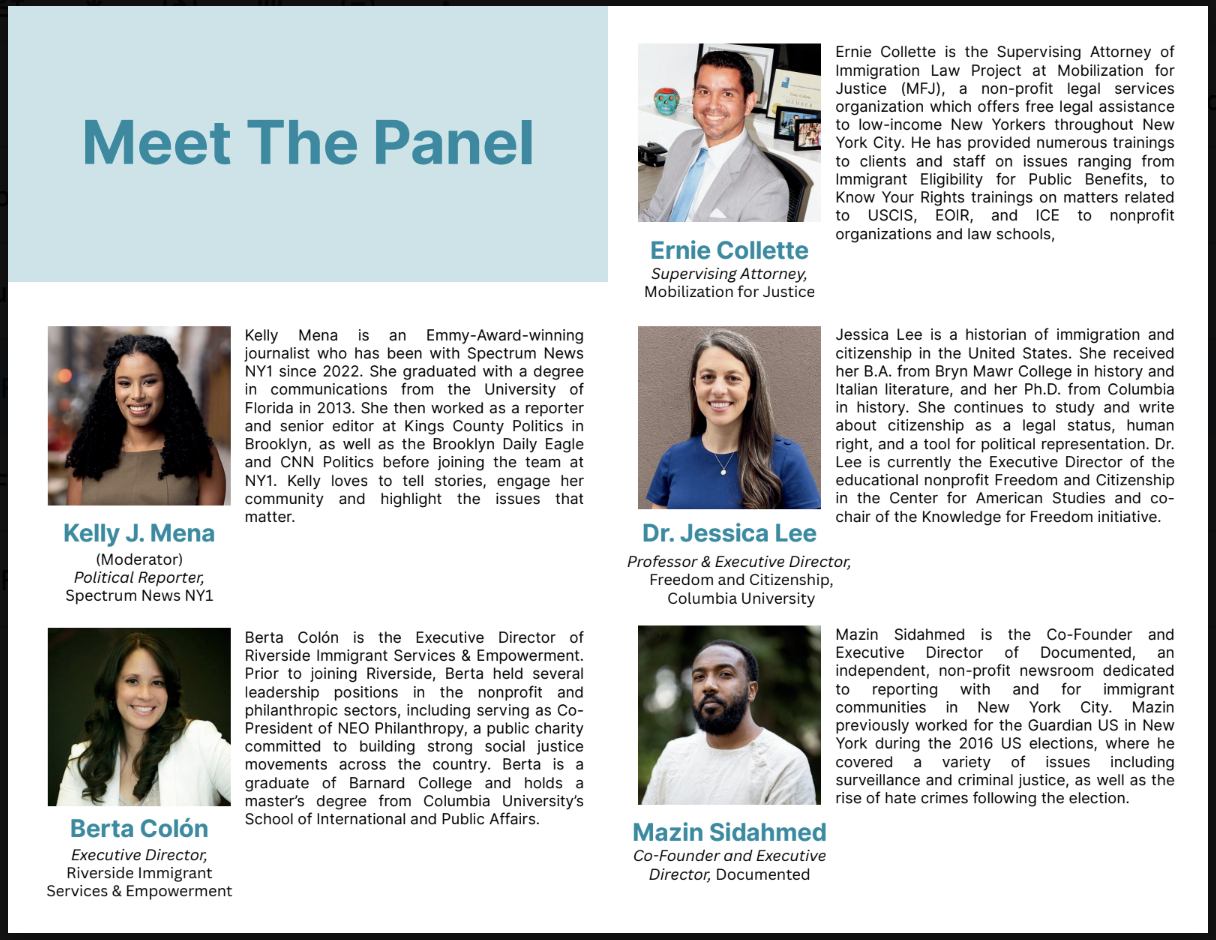
On March 31, 2026, Riverside convened leaders across social services, legal, advocacy, media, and academia to examine how current conditions are impacting immigrant communities and the systems designed to support them. Panelists described a shared reality: systems are under increasing strain, and the scale and complexity of need continue to grow. In this context, Riverside plays a key role connecting English language instruction with legal services, workforce development, media literacy, and essential needs support through a trusted network of community partners. The executive brief includes insights from the live panel conversation and what this moment requires of all of us.